
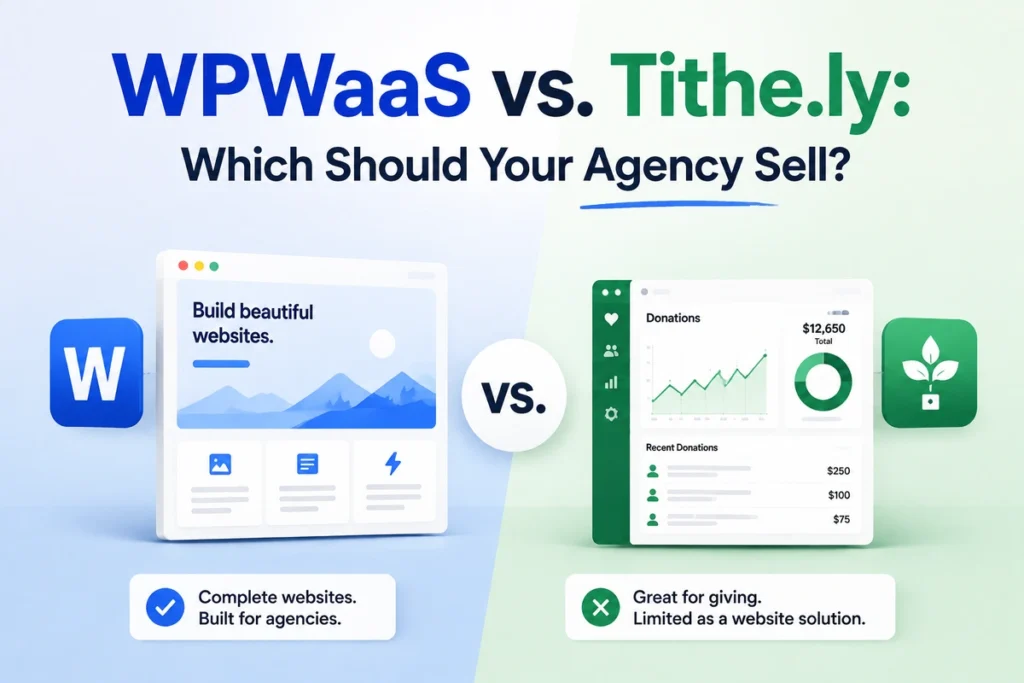
If a church you work with needs online giving and membership tools, Tithe.ly is one of the first names that comes up. It’s a well-regarded platform for what it does. It’s also not something your agency can resell, white-label, or build a client relationship around – the church signs up directly, pays Tithe.ly directly, and your agency is nowhere in that transaction.
Tithe.ly sells church management and giving software directly to churches, on its own branding, at its own price. WPWaaS, on the other hand, is a solid tithe.ly alternative that sells the infrastructure to agencies, who deploy their own version of a comparable portal under their own brand and set their own price.
Same category of problem for the church, a completely different business model for the agency in the middle.
What Tithe.ly Actually Is
Tithe.ly started as an online giving platform and has expanded into broader church management over time, including through its 2022 acquisition of Breeze ChMS.
Its giving and mobile donation tools are widely regarded as strong – some independent reviews rate the giving experience as best-in-class in the category, while noting the church-management side feels less integrated, having grown mainly through that acquisition rather than being built as one system from the start.
As of current publicly listed pricing, the giving tools have a free tier (with per-transaction fees), and the fuller platform runs roughly $49–$149 a month depending on features, with Breeze available separately at a flat $72/month or bundled with Tithe.ly’s apps and sites for $119/month.
None of that is a criticism of the product. It’s a genuinely capable platform for a church buying software directly. The point where it stops being relevant to an agency is simple: there’s no reseller layer.
An agency that recommends Tithe.ly to a client has done the client a favor and generated no recurring revenue for itself. So if you run your own web design agency, it makes sense to look for good tithe.ly alternatives, and hopefully make some money from them.
The Difference That Actually Matters: Who the Client Pays
This is really the whole comparison. With Tithe.ly, the billing relationship is between the church and Tithe.ly. The agency might get a one-time setup fee for configuring it, if that, and then has no ongoing role in the subscription at all.
WPWaaS is a great tithe.ly alternative, especially for agencies, because the billing relationship is between the church and the agency – the agency sets the price, issues the invoice, and keeps 100% of what it charges, while WPWaaS is billed separately by tenant site count, invisible to the end client entirely.
Every month a client stays on a directly-sold platform like Tithe.ly is a month of recurring revenue an agency could have kept for itself, for what is, from the client’s point of view, a comparable set of tools.
Feature Comparison
| Tithe.ly | WPWaaS Church Portal | |
| Who the church pays | Tithe.ly, directly | The agency, directly |
| Who sets the price | Tithe.ly | The agency |
| Branding the church sees | Tithe.ly’s | The agency’s, fully white-labeled |
| Online giving | Yes – a core strength | Yes |
| Membership records | Yes (via Breeze) | Yes |
| Attendance tracking | Yes (via Breeze) | Yes |
| Events, sermons, groups | Yes (varies by bundle) | Yes |
| Mobile money / multi-currency giving | Not a core focus | Built in |
| Agency reseller / white-label model | None | Core to the product |
| Pricing basis | Per church, tiered by features | Per agency, billed by tenant site count |
When Does It Make Sense to Point a Client at Tithe.ly Directly?
If the agency’s role in a project ends at launch – a one-time build with no interest in an ongoing software relationship – recommending an established, direct-to-church platform like Tithe.ly is a perfectly reasonable thing to do. Not every agency wants to be in the software-reselling business, and that’s a legitimate choice.
When Does Reselling Your Own Tithe.ly alternative Make More Sense?
For agencies that already work with multiple churches, or want to, the calculus changes. Recurring revenue from a resold product compounds across every client on the platform, in a way that referring clients to someone else’s SaaS never does. The agency also keeps the entire client relationship – support requests, upsells, and renewals all flow through the agency, not a third-party vendor’s support team.
If that’s the direction you’re evaluating, see how the Church Portal deploys, check how the setup process works, or compare plan pricing against how many church clients you’re already working with.